
You've set this goal before. Written it down. Maybe even told a friend. And then, somewhere around week three, life happened — and the goal quietly disappeared into the background noise of your day.
This isn't a willpower problem. It's a structure problem. And the fix isn't more motivation. It's the right person in your corner.
The Real Reason Accountability Works
Most people think accountability is about moral support. It isn't. It's about social architecture.
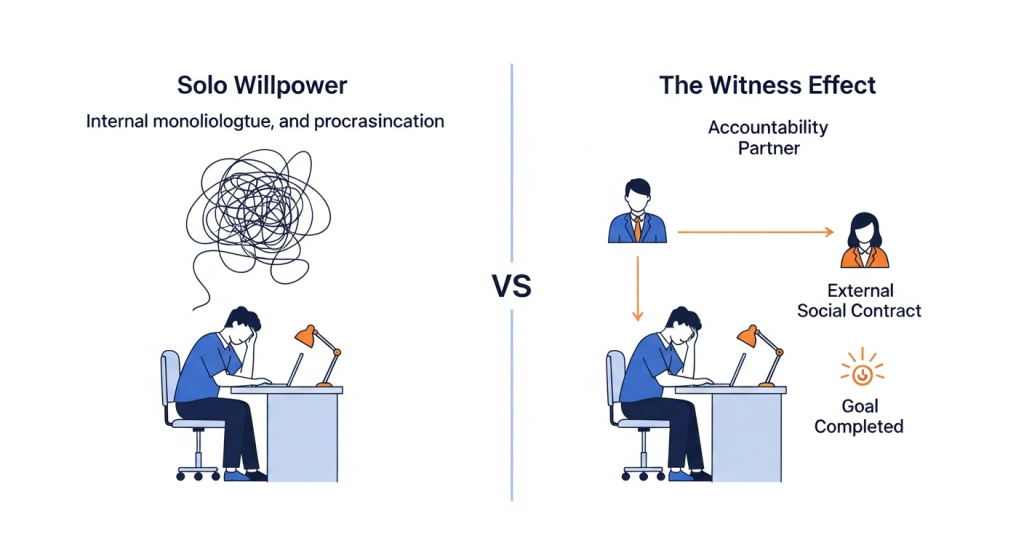
Here's what the research actually shows: we perform differently when someone else is watching. Not because we're trying to impress them — but because our brains treat social commitments differently than private ones. When you tell someone what you're going to do, your brain attaches a social stake to that goal. Suddenly, inaction has a cost.
Psychologists call this the "witness effect." The moment a task becomes a public commitment — even to just one other person — the path of least resistance shifts. Doing the thing becomes easier than explaining why you didn't.
That's not a motivational trick. That's biology working in your favor.
Why Your Best Friend Might Be the Wrong Choice
This one surprises people. But picking someone too close to you can actually work against you.
Close friendships are built on unconditional support. That's exactly what you need when life gets hard — and exactly what undermines accountability when you miss a deadline. A best friend will say "it's okay, you've been through a lot." And they mean it kindly. But that kindness quietly removes the social pressure that makes accountability work.
What you actually need is someone with a little professional distance. Someone who'll ask the hard question — "Why did you spend the week on low-priority tasks instead of the thing that matters?" — and mean it without the emotional baggage.
The goal isn't someone who loves you unconditionally. It's someone who respects you enough to hold you to the standard you set for yourself.
Peer, Group, or App — What Do You Actually Need?
Not every goal needs the same support structure. Before you go looking, get honest about what you're missing.
If you need consistency, a peer partner is your best move. Two people, similar goals, checking in regularly. The reciprocity keeps both of you honest. It works especially well for habit formation and long-term projects where the path is known but the follow-through is the hard part.
If you need perspective, a small accountability group — what we call a Dorp inside Dorpamine — gives you something a one-on-one can't: collective intelligence. When you're stuck, you get more than one angle. The tradeoff is coordination. Groups require more structure to stay effective.
If you need consistency on a simple habit, technology can fill the gap. Streak mechanics, reminders, and progress tracking remove the friction of scheduling a human check-in. Sometimes that's exactly enough.
The honest question to ask yourself: am I lacking clarity, motivation, or consistency? Your answer tells you what kind of support to look for.
How to Set Up a Partnership That Actually Holds
Most accountability partnerships fail for one reason: no clear terms. You start with good intentions, check in a few times, and then the whole thing quietly dissolves.
Here's how to build one that sticks.
Start with specific milestones. Vague goals create vague accountability. "I want to work on my business" is not a commitment. "I'll have the landing page copy drafted by Thursday at noon" is. When the milestone is concrete, there's no room to mistake effort for results.
Agree on your cadence upfront. How often will you check in? Through what channel? A 15-minute weekly sync is often enough to keep momentum going. What matters more than duration is consistency. Pick a rhythm and protect it.
Build in a graceful exit. What happens if one of you stops showing up? Decide in advance. Agree that two missed check-ins without notice means the partnership is over. This removes the guilt and awkwardness of having to "break up" with someone who's no longer pulling their weight. It also keeps the standard high from day one.
Where Dorpamine Fits Into This
We built Dorpamine around one core insight: structure beats willpower. Every single time.
That's why the Accountability Partner feature inside Dorpamine isn't just a connection — it's a system. Your partner can view your Goals, leave feedback on your Progress Journal, and show up for you in ways that go beyond a group chat or a casual text thread.
And if you're ready for something deeper, Dorps give you a small, focused group — up to five people — who are genuinely invested in whether you hit your goals. Not cheerleaders. Not critics. People who'll ask the hard question and mean it.
The Hot Seat takes it even further. For 72 hours, your group puts everything else aside and focuses entirely on one member's goals and roadblocks. It's the kind of targeted support most people never get — and it changes how fast you move.
We cap active goals at 3. On purpose. Because clarity beats a full list every time — and the goals that actually matter deserve your full attention.
The Simple Truth About Accountability
You don't need more motivation. You need a structure that makes inaction uncomfortable and progress expected.
The right accountability partner — or the right group — doesn't just keep you on track. They change what "on track" feels like. Showing up stops being a discipline problem. It becomes a social norm.
That shift is quiet. But it's everything.
If any of this resonated, you might be exactly who Dorpamine was built for. It's free, it's growing, and the people already in it are doing real work.